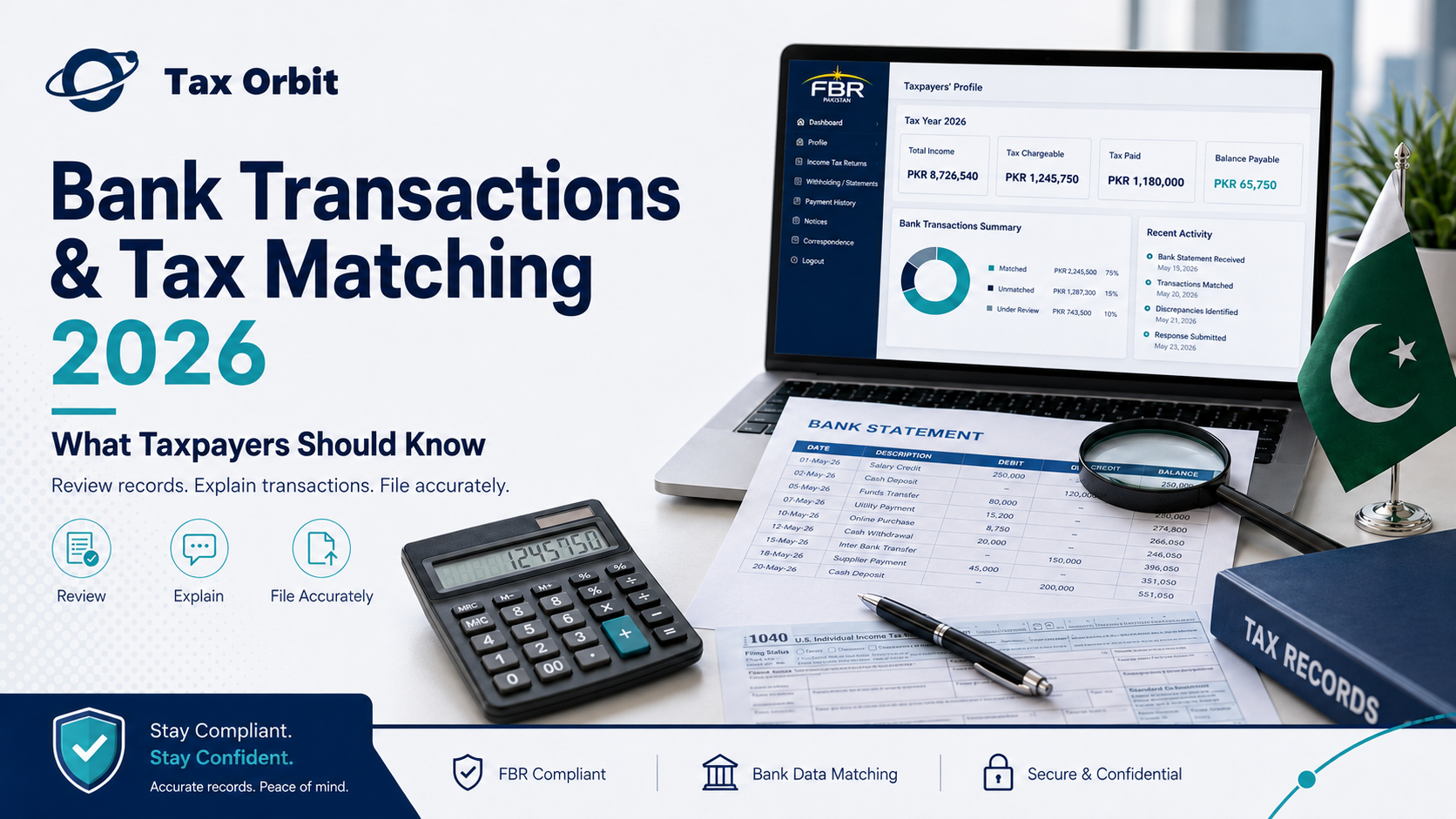
FBR Bank Transaction Cross-Matching in 2026: What Taxpayers in Pakistan Should Know
Pakistan’s tax system is becoming increasingly data-driven.
Under the Finance Act 2026, the Federal Board of Revenue (FBR) has strengthened technology-based tax compliance, including the algorithmic cross-matching of banking and tax information.
According to FBR’s official 2026–27 budget highlights, banking companies and Electronic Money Institutions may electronically provide information relating to high-value deposits and withdrawals for comparison with tax declarations. The purpose is to identify significant mismatches and broaden the tax base.
For taxpayers, this makes accurate and properly documented tax filing more important than ever.
What Does Bank and Tax Data Cross-Matching Mean?
In simple terms, the system can compare certain financial information with the figures declared in a taxpayer’s tax records.
For example, if significant banking activity does not appear consistent with declared income or financial information, the system may identify a mismatch for further review.
This does not automatically mean that the taxpayer has done something wrong. There may be perfectly legitimate explanations for transactions, such as:
-
Transfers between your own accounts
-
Business receipts
-
Sale of an asset
-
Properly documented loans
-
Gifts received in accordance with applicable rules
-
Investment proceeds
-
Other legitimate sources of funds
The important point is that significant financial activity should be properly explainable and supported by records.
Is FBR Manually Watching Every Bank Transaction?
The 2026 framework is described by FBR as algorithmic cross-matching.
That means technology is being used to compare relevant banking information with tax declarations and identify significant inconsistencies rather than simply treating every transaction as a tax violation.
FBR’s 2026 reforms also include increased use of technology through measures such as a National Faceless Centre for certain audits, assessments and appeals, as well as an algorithmic settlement mechanism for identified discrepancies.
Why Does This Matter When Filing Your Tax Return?
Your tax return should present an accurate picture of your financial position.
A major mismatch between your declared income, assets or financial activity and available records can create unnecessary questions later.
Before filing, taxpayers should therefore review their information carefully instead of simply entering estimates.
What Should You Review Before Filing?
Consider reviewing the following information before submitting your return:
-
Bank statements for the relevant period
-
Salary and employment income
-
Business receipts
-
Freelance or professional income
-
Major cash deposits
-
Property purchased or sold
-
Vehicle purchases or disposals
-
Investments
-
Loans received or repaid
-
Significant gifts or transfers
-
Transfers between your own bank accounts
-
Previous Wealth Statement
-
Current assets and liabilities
Not every item will apply to every taxpayer, but significant transactions should generally have a clear explanation and supporting record.
Business Owners Should Be Especially Careful
For businesses, bank turnover may not be the same thing as taxable profit.
A business account can contain:
-
Customer collections
-
Supplier refunds
-
Capital introduced by the owner
-
Loans
-
Transfers between accounts
-
Other legitimate business transactions
However, poor bookkeeping can make it difficult to explain these amounts later.
Maintaining proper books and separating personal and business transactions can make tax preparation significantly easier.
What About Transfers Between Your Own Accounts?
Moving money from one of your own accounts to another does not by itself create new income.
However, if records are unclear, the same money may appear multiple times across bank statements.
That is why reconciliation is important. Your accountant or tax adviser should be able to identify internal transfers and distinguish them from actual income or other financial inflows.
Keep Documents for Large or Unusual Transactions
For significant transactions, keeping supporting documents can help establish the source and nature of the funds.
Depending on the transaction, useful documents may include:
-
Bank statements
-
Sale agreements
-
Property documents
-
Loan agreements
-
Business invoices
-
Payment receipts
-
Investment statements
-
Relevant correspondence
-
Previous tax returns and Wealth Statements
Accurate documentation is generally much easier to deal with than trying to reconstruct a transaction months or years later.
Do Not Hide or Invent Figures to Force a Match
Tax returns and Wealth Statements should reflect actual financial circumstances.
Do not enter artificial expenses, assets, liabilities or other figures simply to make financial information appear consistent.
If you find a genuine difference that you cannot explain, investigate it before filing.
The 30 September Filing Deadline Is Approaching
FBR lists the general income tax return filing deadline for individuals and Associations of Persons (AOPs) as on or before 30 September. Companies generally have a 31 December deadline, while companies with a special tax year may also have a 30 September due date.
With greater use of automated data comparison, accurate filing and proper recordkeeping are increasingly important.
Do not wait until the final days to review your bank records, income and assets.
How TaxOrbit Can Help
If you are unsure whether your bank transactions, declared income and Wealth Statement are properly aligned, TaxOrbit can help you review your records before filing.
Our team can assist with:
-
Income tax return preparation
-
Wealth Statement review
-
Bank transaction reconciliation
-
Business income review
-
Identification of documentation gaps
-
FBR compliance support
Contact TaxOrbit
📱 0301-6060602
☎ 021-38547550
✉ taxorbit360@gmail.com
🌐 taxorbit.com.pk
Review your records. Explain your transactions. File accurately.
Disclaimer
This article is for general informational purposes only and does not constitute tax, accounting or legal advice. The treatment of individual transactions depends on the taxpayer’s circumstances and applicable law. Professional advice should be obtained where required.